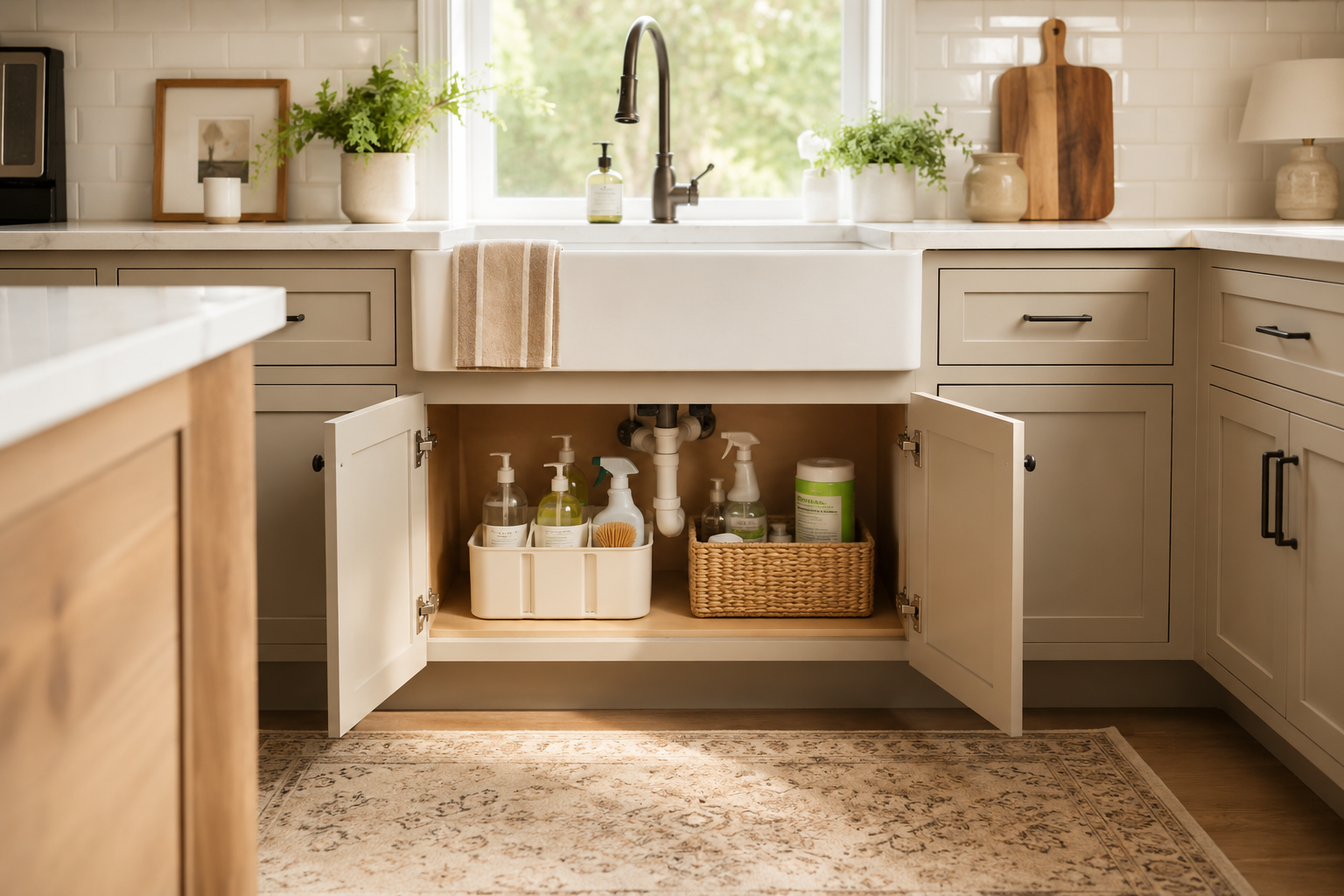
How to Organize Cleaning Supplies So Cleaning Takes Less Time
Simple cleaning systems make everyday routines easier by keeping the supplies you use most close to where you need them.
There are some days when cleaning feels harder than the actual mess.
You notice fingerprints on the bathroom mirror—but the glass cleaner is downstairs.
There are crumbs under the kitchen table—but the broom is in the garage.
Something spills upstairs, and suddenly cleaning it means walking through the house looking for the right spray, cloth, or brush.
None of these things takes very long to clean.
Finding what you need is what makes cleaning feel like a bigger job.
A simpler cleaning routine starts by changing where your supplies live.
Instead of storing every cleaning product together because that's where cleaning supplies are "supposed" to go, keep the things you use most often close to the places where you actually use them.
It's a small shift, but it removes unnecessary steps from everyday cleaning.
And when cleaning becomes easier to start, it's usually easier to keep up with too.
Why Cleaning Supplies Become So Hard to Manage
Most homes accumulate cleaning products gradually.
A bottle gets tucked under the kitchen sink. Another ends up in the laundry room. Extra sprays collect in a closet. Specialty cleaners get pushed behind things we use more often.
Before long, we have plenty of cleaning supplies—but not necessarily a system for using them.
The problem usually isn't that you need better storage.
It's that the supplies aren't living where your routines happen.
When every small cleaning task requires gathering supplies from somewhere else, we naturally put more of those tasks off until later.
Instead, think about cleaning supplies as part of the room they support.
The goal isn't to create a perfectly organized collection of bottles.
The goal is to make everyday cleaning take less effort.
1. Start With the Cleaning Tasks You Actually Do
Before reorganizing anything, pay attention to how you really clean your home.
Not how you think you should clean.
Think about the little jobs that happen over and over again.
Wiping the kitchen counters.
Cleaning a bathroom mirror.
Quickly wiping down a sink.
Cleaning the dining table after dinner.
Sweeping crumbs from the kitchen floor.
Wiping muddy paw prints near an entry.
These repetitive tasks are the best place to start because they're where a simple system can save you time every single week.
For each space, ask:
What do I reach for most often when I clean this room?
Those are the supplies that deserve the easiest-to-reach homes.
2. Keep Everyday Supplies Near Where You Use Them
This is the biggest change you can make.
Instead of creating one central location for every cleaning product in the house, create small cleaning zones near the places where cleaning actually happens.
That doesn't mean filling every room with cleaning products.
It means strategically placing a few frequently used essentials where they remove an extra step from your routine.
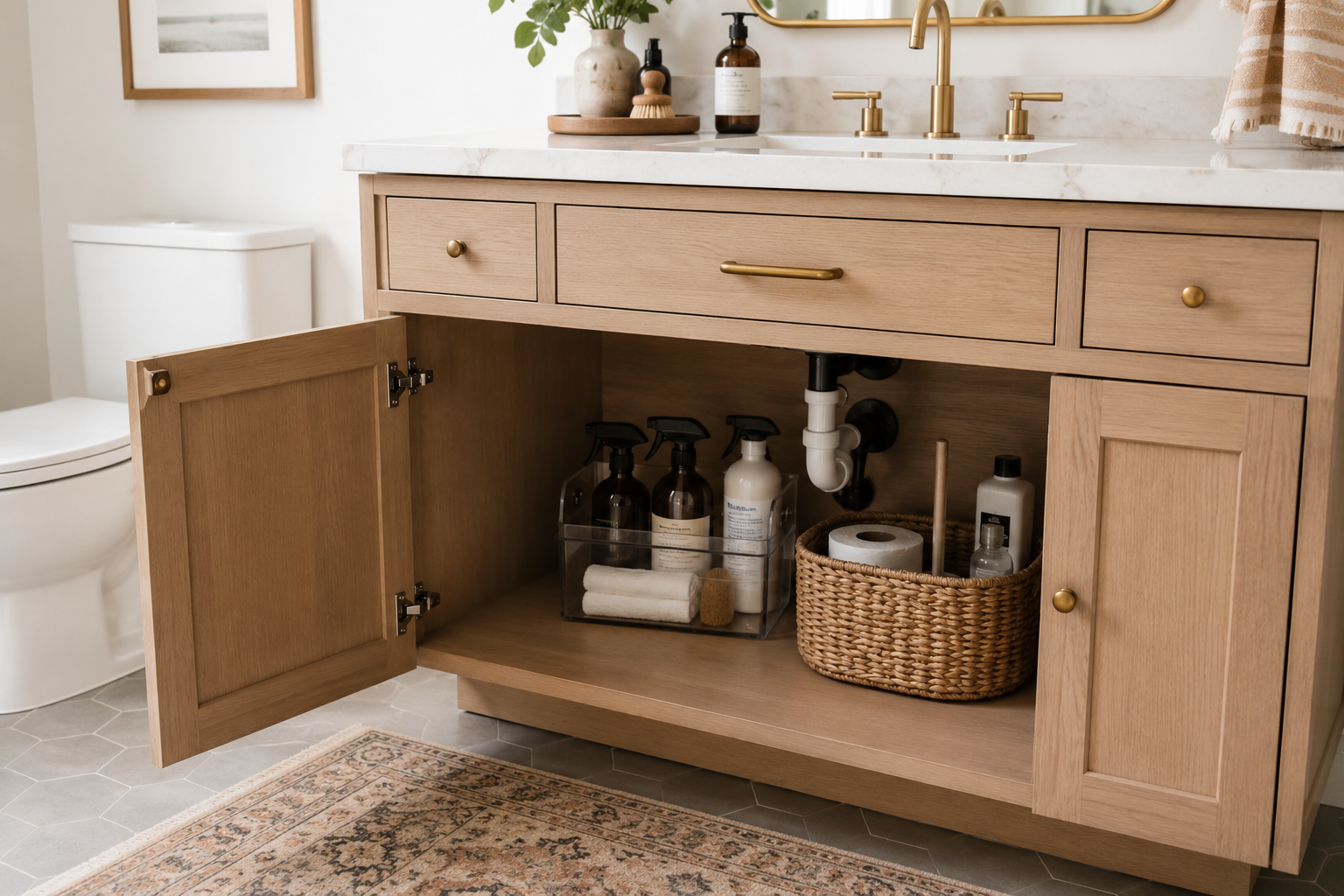
In the kitchen
You might keep:
an everyday surface cleaner
a few microfiber cloths
dish soap
a scrub brush
dishwasher supplies
In the bathrooms
You might keep:
bathroom cleaner
glass cleaner
a cleaning cloth or sponge
toilet cleaner and brush
Near the main living area
Depending on your home, it may be helpful to have quick access to:
a microfiber cloth
a small duster
a handheld vacuum or nearby vacuum
The exact supplies will be different in every home.
That's the point.
Your cleaning system should support the way you live—not someone else's idea of an organized cleaning cabinet.
3. Create Small Cleaning Kits for Repetitive Jobs
Some cleaning routines require two or three things every time.
Instead of storing those items separately, group them together.
A small bathroom cleaning kit, for example, could hold the spray and cloths you use for quick sink and mirror cleanups.
A kitchen cleaning kit might contain the supplies you use after dinner.
These don't need elaborate containers.
A simple handled caddy, small bin, or basket can work beautifully.
The container isn't the system.
Keeping the things you use together in one easy-to-grab place is the system.
That's what saves time.
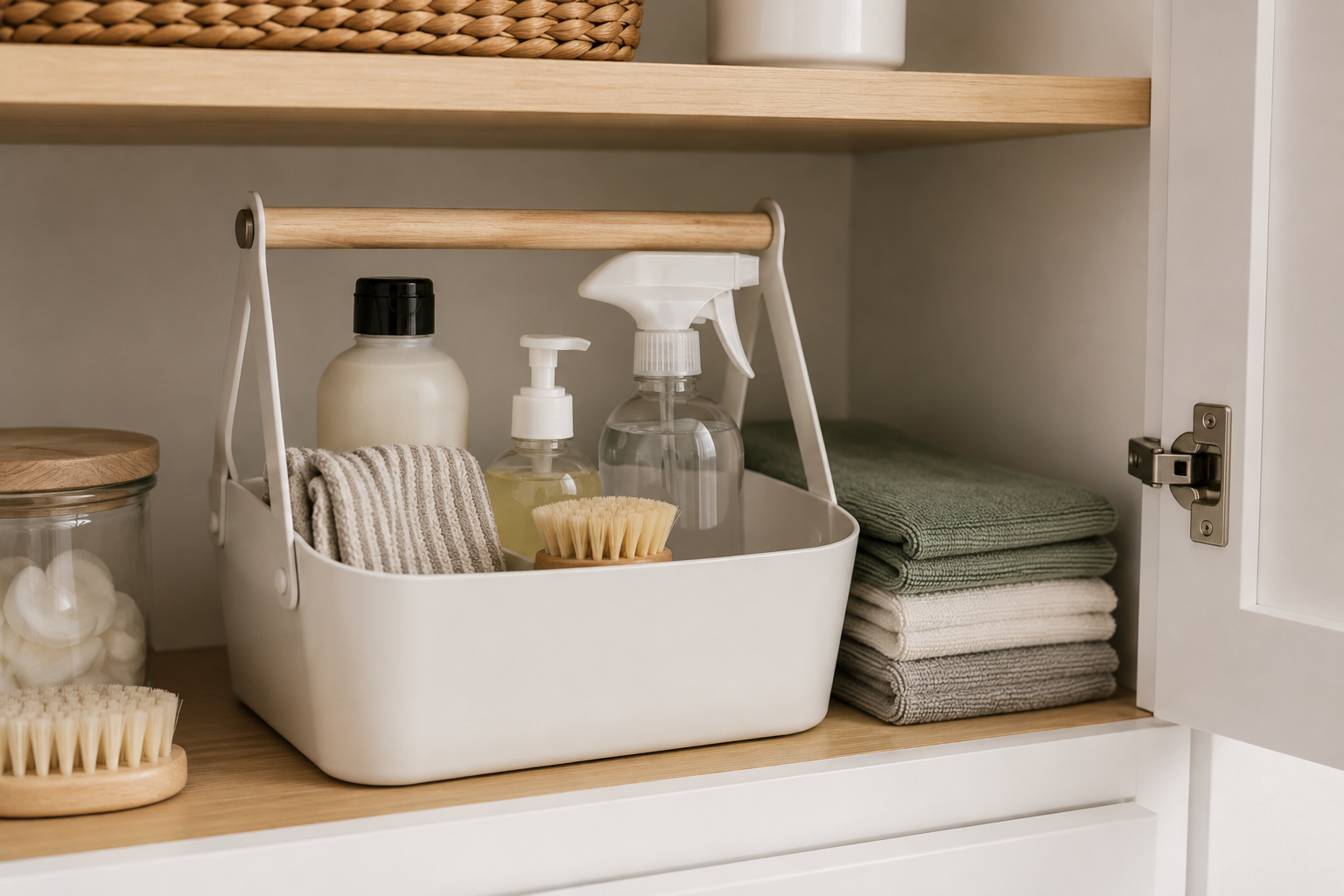
4. Separate Everyday Cleaning From Deep Cleaning
One reason cleaning storage becomes cluttered is that everyday products get mixed together with things we rarely use.
Oven cleaner.
Silver polish.
Carpet treatment.
Specialty stain removers.
Extra refills.
These products can be useful, but they don't need to take up the easiest-to-reach spaces in your home.
Keep your everyday cleaning supplies accessible and move occasional-use products to a secondary storage area.
That might be:
a laundry room cabinet
a utility closet
a garage shelf
a higher cabinet
a labeled storage bin
This creates a simple hierarchy.
Daily-use supplies stay close. Occasional-use supplies can live farther away.
You aren't getting rid of useful products.
You're simply giving the most convenient space to the things that make everyday life easier.
5. Stop Keeping Too Many Versions of the Same Thing
Cleaning cabinets have a way of collecting duplicates.
Three partially used surface sprays.
Several different glass cleaners.
Specialty products purchased for one specific mess.
Bottles we tried but didn't particularly like.
Before organizing everything, pull out what you have and look for overlap.
You probably don't need a different cleaner for every surface in your home.
Keep the products you actually use and finish those before buying more.
Fewer bottles make it easier to see what you have, easier to find what you need, and easier to keep your cleaning areas organized.
Simple is enough.
6. Give Refills and Backstock Their Own Home
Extra cleaning supplies are useful.
They're also one of the easiest ways to overwhelm your everyday cleaning areas.
If you buy refills or multipacks, keep the extras together in one designated backstock location rather than distributing them throughout the house.
Then your bathroom cabinet doesn't need three bottles of the same cleaner.
It only needs the one you're currently using.
When it runs out, you know exactly where to find the replacement.
This also makes it much easier to see what you already own before buying more.
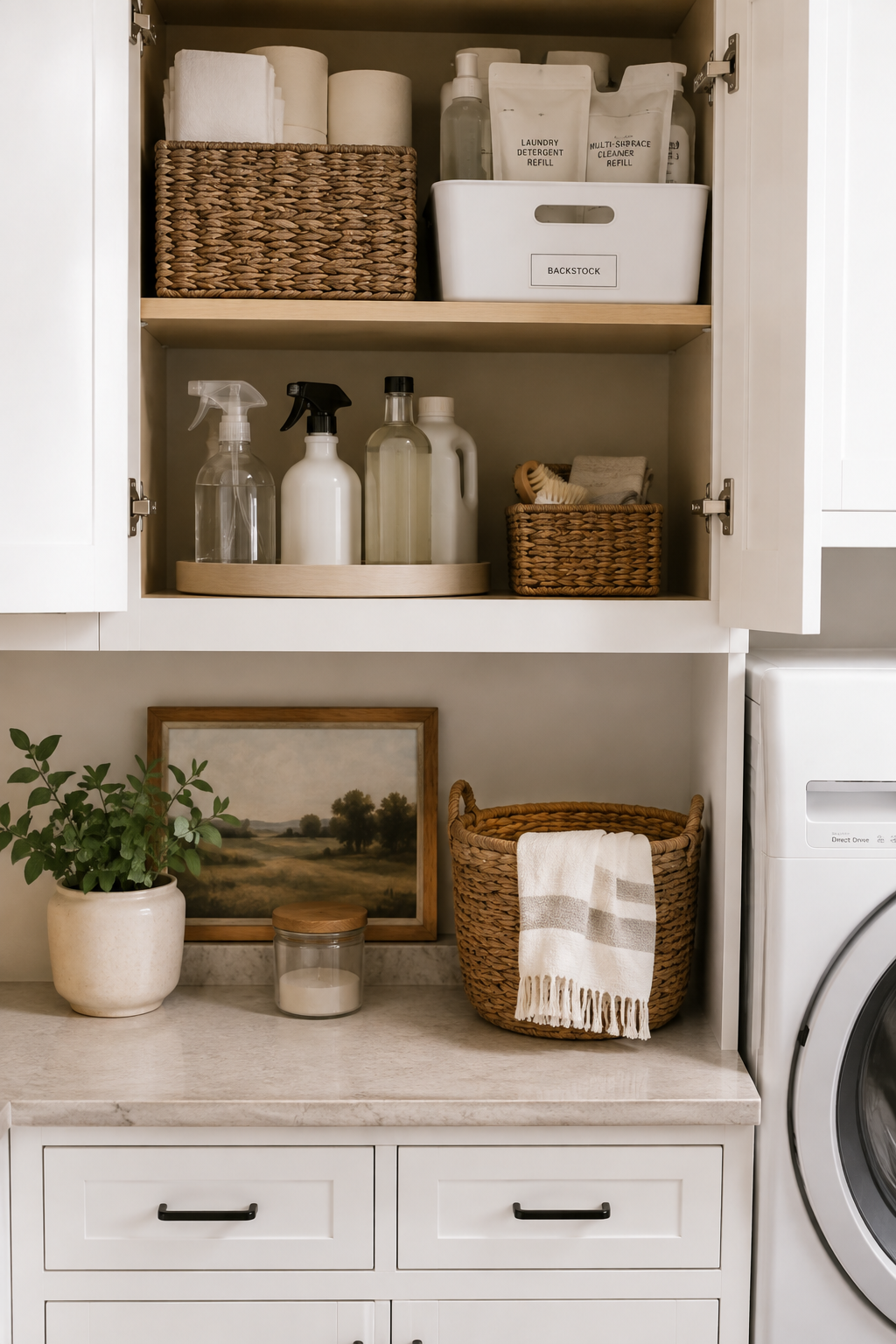
7. Make the System Easy to Reset
Any organization system works better when putting things away takes almost no effort.
Avoid creating cleaning storage that requires you to carefully rearrange bottles every time you use something.
Keep categories broad.
Give frequently used items enough space.
Use containers only when they make things easier to grab or return.
And leave a little breathing room.
If the cleaning caddy is packed so tightly that you have to remove three bottles to reach one, the system is working against you.
The goal is simple:
Use it. Put it back. Move on with your day.
8. Let Your Cleaning Supplies Follow Your Routine
There is no rule that says every cleaning product has to live in the same cabinet.
Your home might work better with supplies in several small zones.
Maybe kitchen cleaners live under the kitchen sink.
Bathroom supplies stay in each bathroom.
Laundry products live beside the washer.
The vacuum lives near the rooms where you use it most.
And specialty products live together in one less-accessible storage area.
Instead of asking:
"Where should cleaning supplies go?"
Ask:
"Where would this be easiest to use?"
That question creates a very different kind of organized home.
One designed around your actual life.
Calm Favorites
You don't need a collection of organizing products to make this system work.
But a few simple tools can make cleaning supplies easier to use and return.
A lightweight handled caddy keeps the supplies used for one routine together and makes them easy to carry when needed.
Simple bins can keep categories from spreading across a cabinet while still making it easy to see what's inside.
Keeping a small stack near the areas where you regularly wipe surfaces removes another step from quick cleanups.
A turntable can help in deeper cabinets where bottles tend to disappear behind one another.
When cabinet space is limited, unused vertical space can sometimes hold lightweight cleaning essentials without taking over the shelf below.
The best cleaning organizer isn't the one that holds the most.
It's the one that makes the things you actually use easier to reach.
A Simpler Cleaning Routine Starts With Fewer Steps
An organized home shouldn't require more work to maintain.
It should quietly remove friction from the things you already do.
Putting cleaning supplies near where you use them won't eliminate cleaning.
But it can eliminate the unnecessary searching, gathering, carrying, and putting away that makes a five-minute task feel much bigger.
Start with one room.
Notice the cleaning task you repeat most often.
Put what you need nearby.
Then live with the system for a while.
If it makes the routine easier, you've created something worth keeping.
Because creating a calmer home isn't about cleaning everything all the time.
It's about creating simple systems that make taking care of your home feel a little easier every day.
Final Thoughts
Cleaning will always be part of taking care of a home, but it doesn't have to feel harder than it needs to.
Sometimes the biggest difference isn't a new cleaning routine or a better product.
It's simply having what you need where you need it.
Start with one space where you find yourself cleaning often. Pay attention to what you repeatedly leave the room to find, and give those few essentials a convenient home nearby.
Then stop there.
You don't need to reorganize every cleaning supply in your house in one afternoon.
One bathroom. One kitchen cabinet. One small cleaning kit.
Small changes like these remove little points of friction from your day—and those are often the systems that make a home noticeably easier to live in.
Because the goal isn't to spend more time cleaning.
It's to create a home that's easier to take care of, so you can spend less time thinking about it.
You May Also Like
If you're creating simpler systems throughout your home, you may also like:
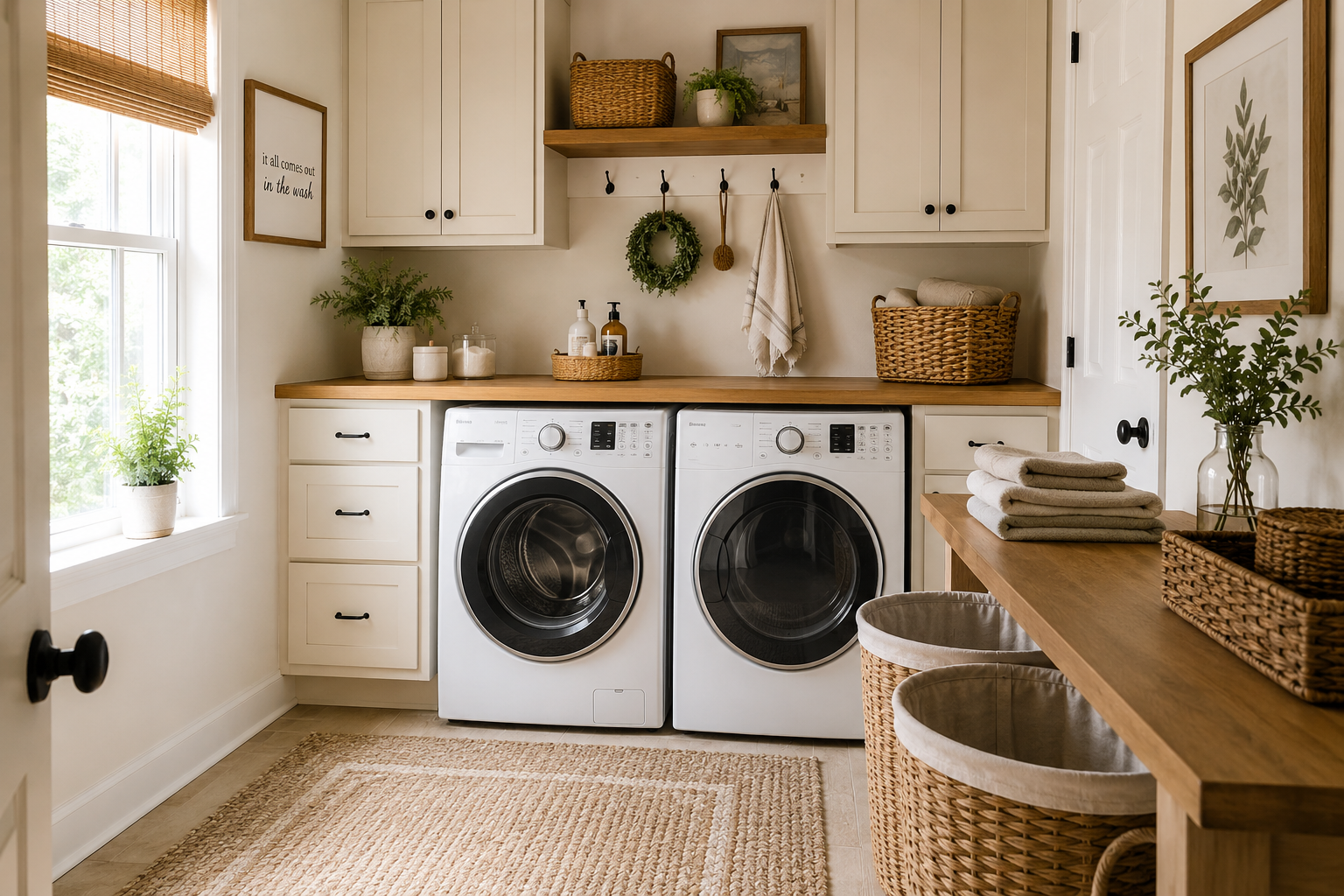
The Laundry Room System That Keeps Clothes Moving
Laundry doesn't need to feel like a never-ending chore. A simple system can keep clothes moving from dirty to washed, dried, folded and put away—while helping your laundry room and your home feel calmer.
Laundry has a way of making a home feel more chaotic than it really is.
A basket of clean clothes waits to be folded. Another load sits forgotten in the dryer. Dirty clothes collect on bedroom floors while a stack of folded clothes waits to make its way upstairs.
And somehow, even though you're doing laundry all week, it never actually feels finished.
The problem may not be that you need to do laundry more often.
It may simply be that your laundry doesn't have a clear path through your home.
A functional laundry system gives clothes somewhere to go at every stage:
Dirty → Wash → Dry → Fold → Put Away
When each step naturally leads to the next, laundry becomes less of a project and more of a routine that quietly keeps moving.
You don't need a picture-perfect laundry room to make that happen.
You just need a system that works.
Why Laundry So Easily Gets Stuck
Most laundry clutter is really just unfinished laundry.
Think about where clothes tend to collect:
On bedroom floors waiting to be washed
In overflowing hampers
In the washing machine waiting to be moved
In the dryer long after the cycle ends
In baskets waiting to be folded
On beds or chairs waiting to be put away
Every pile marks a place where the process stopped.
That's why adding more storage to your laundry room doesn't always solve the problem.
Instead of asking, "Where can I store more things?" ask:
"What would make it easier for the laundry to move to the next step?"
That one shift turns laundry-room organization into a system instead of a storage project.
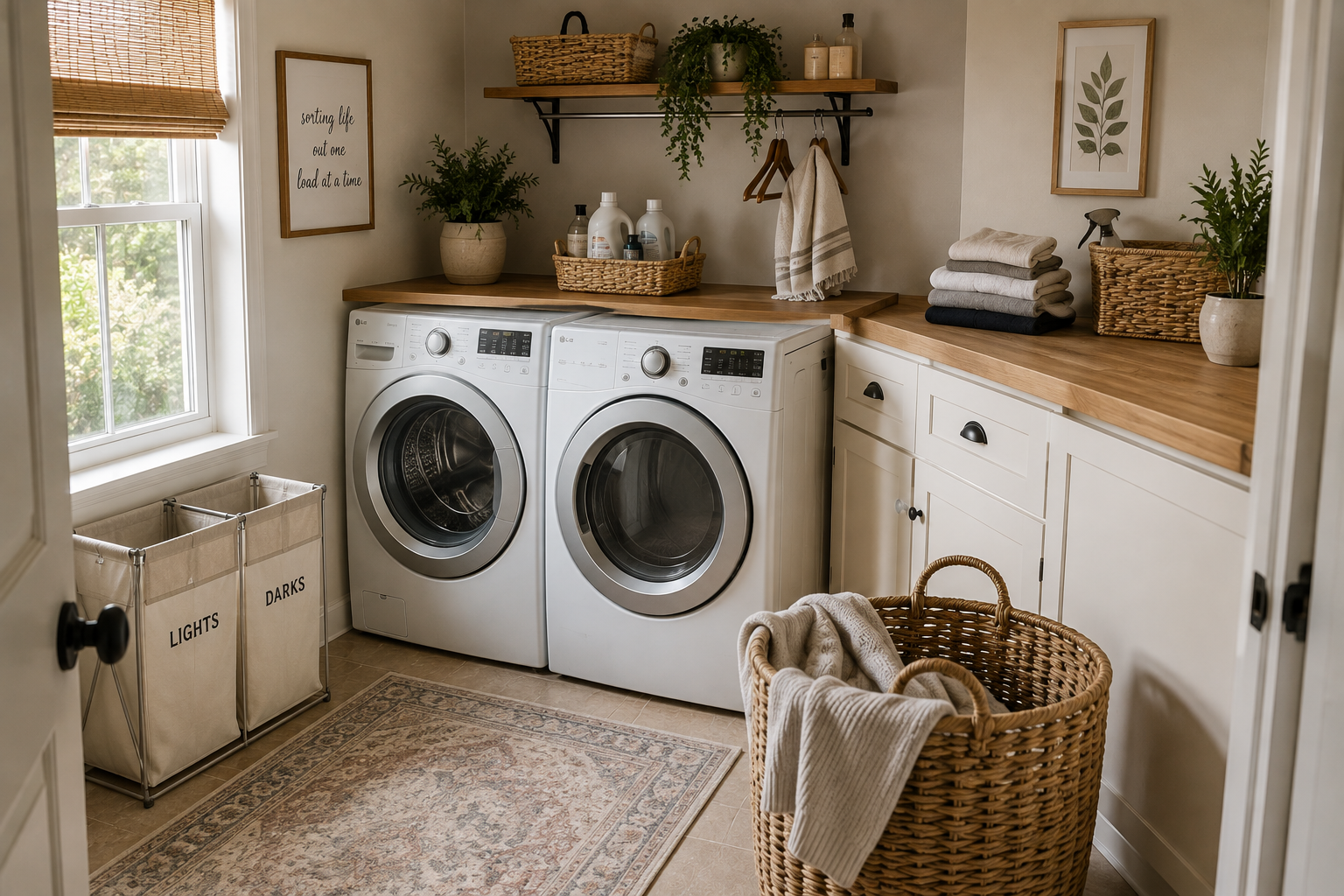
1. Start With a Better Dirty-Laundry System
Your laundry system starts long before clothes reach the washing machine.
If dirty clothes regularly end up on bathroom floors, bedroom chairs, or beside the hamper, don't assume everyone needs to try harder.
Look at the system first.
Place hampers where clothes naturally come off—usually bedrooms, closets, or bathrooms.
Then keep sorting as simple as possible.
Your household might use:
One hamper for everything
A divided hamper for lights and darks
Separate hampers for each family member
One additional basket for towels or delicates
There isn't one correct way.
The best hamper system is the one your household can use without thinking about it.
If five categories create five piles on the floor, you don't need better labels.
You need fewer categories.
Simple is enough.
2. Give Laundry a Trigger
One reason laundry becomes overwhelming is that we often wait until the hamper tells us there's a problem.
Instead, create a simple trigger for starting a load.
Maybe you start one when the hamper is three-quarters full.
Maybe towels are always washed on the same day.
Maybe you put a load in before making breakfast.
You don't necessarily need a complicated laundry schedule.
You simply need something that removes the constant question:
"Should I do laundry today?"
Small routines prevent laundry from becoming an all-day weekend project.
3. Keep Everyday Supplies Where You Use Them
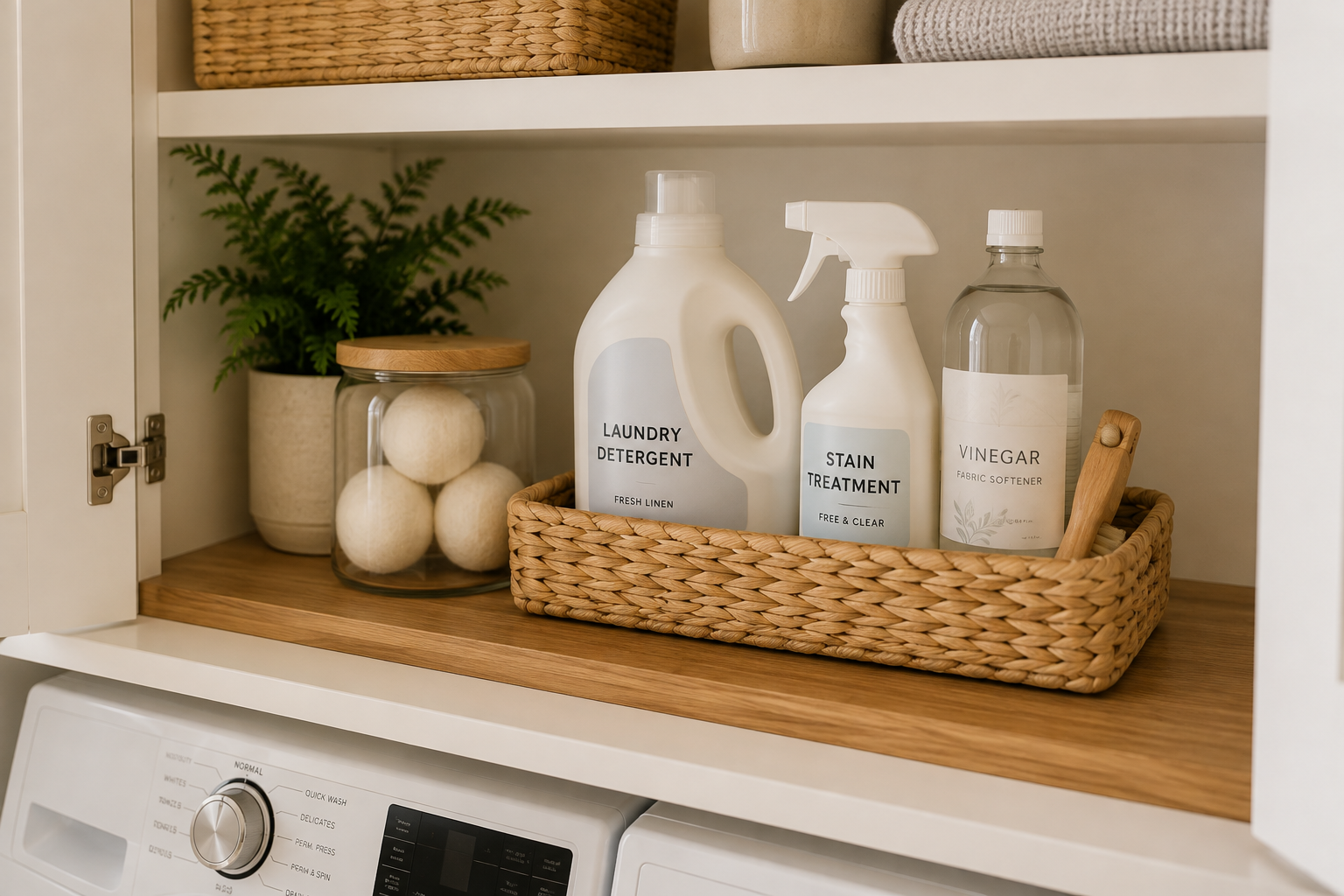
Detergent, stain remover, dryer sheets, wool dryer balls, and other everyday supplies should be easy to reach.
That doesn't mean everything needs to be poured into matching containers.
If transferring detergent into a pretty jar gives you another job to maintain, leave it in the original container.
Organization should make life easier—not create more work.
Keep frequently used supplies together on a shelf, inside a cabinet, or on a simple tray near the washer.
Move backup products and less-used supplies farther away.
The things you use most should always be the easiest things to reach.
4. Create a Small Zone for Clothes That Need Attention
Every laundry room seems to collect a few things that don't fit neatly into the normal routine.
The shirt with a stain.
The sweater that needs to air dry.
The pants missing a button.
The sock waiting for its match.
Without a designated place, these items tend to sit on top of the washer indefinitely.
Give them a small holding zone instead.
A shallow basket can hold pieces that need attention.
A small container can collect unmatched socks.
A hanging rod or fold-down rack can give air-dry clothing somewhere to go.
The key word is small.
You don't want to create a new place to store unfinished tasks forever.
You simply want a temporary landing place until you can finish them.
5. Make Moving the Load Almost Automatic
One of the easiest places for laundry to stall is inside the washing machine.
The goal isn't to become better at remembering it.
The goal is to create a cue that does the remembering for you.
You might:
Set a timer when the washer starts
Start laundry before a routine you already have
Move the load after breakfast
Transfer it before leaving for an errand
Use your washer's notification feature if it has one
Tie laundry to something that already happens in your day.
The fewer things your brain has to remember, the easier the routine becomes.
Good systems carry some of the mental load for you.
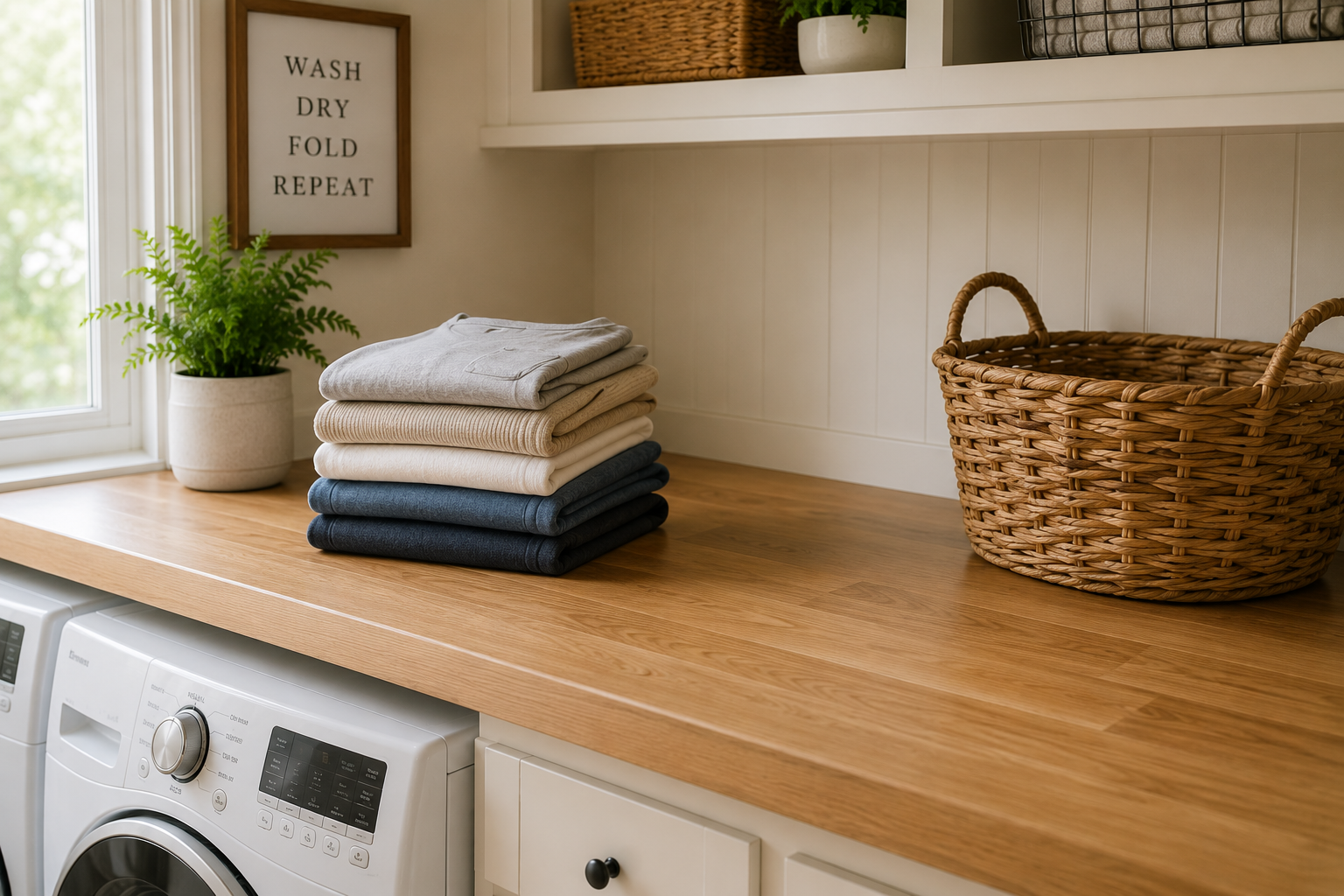
6. Protect One Folding Surface
Clean laundry often gets stuck because there isn't an obvious next step after it leaves the dryer.
Choose one predictable folding spot.
It could be:
A laundry-room counter
The top of the washer and dryer
Your bed
A folding table
A kitchen island
You don't need a large laundry room.
You just need a surface that's available when you need it.
If you have a laundry counter, resist letting it become permanent storage for shopping bags, cleaning products, packages, and miscellaneous household items.
A clear folding surface removes one more obstacle between dry and done.
7. Make "Put Away" Part of the System
Laundry isn't finished when it's folded.
It's finished when it's put away.
If clean clothes regularly live in baskets for several days, look at what makes that final step difficult.
Are drawers too full?
Are closets overcrowded?
Is everyone's clothing mixed together in one basket?
Does the basket get carried upstairs and then forgotten?
Sometimes the best laundry-room solution happens somewhere else in the house.
Try sorting folded clothing by person before it leaves your folding area.
If it helps, give each family member a basket.
When the basket is full, it goes directly to that person's room.
And if putting clothes away still feels unusually difficult, take a look inside the dresser or closet.
Making room where clothing actually belongs may improve your laundry routine more than another laundry organizer ever could.
8. Finish With a Two-Minute Laundry Reset
When the last load is finished, spend two minutes resetting the space.
Put the detergent back.
Clear the folding surface.
Empty the lint trap.
Return empty baskets.
Hang anything that needs to finish drying.
And check the washer one last time.
The room doesn't need to look perfect.
You're simply making tomorrow's first load easier.
That's what a reset should do.
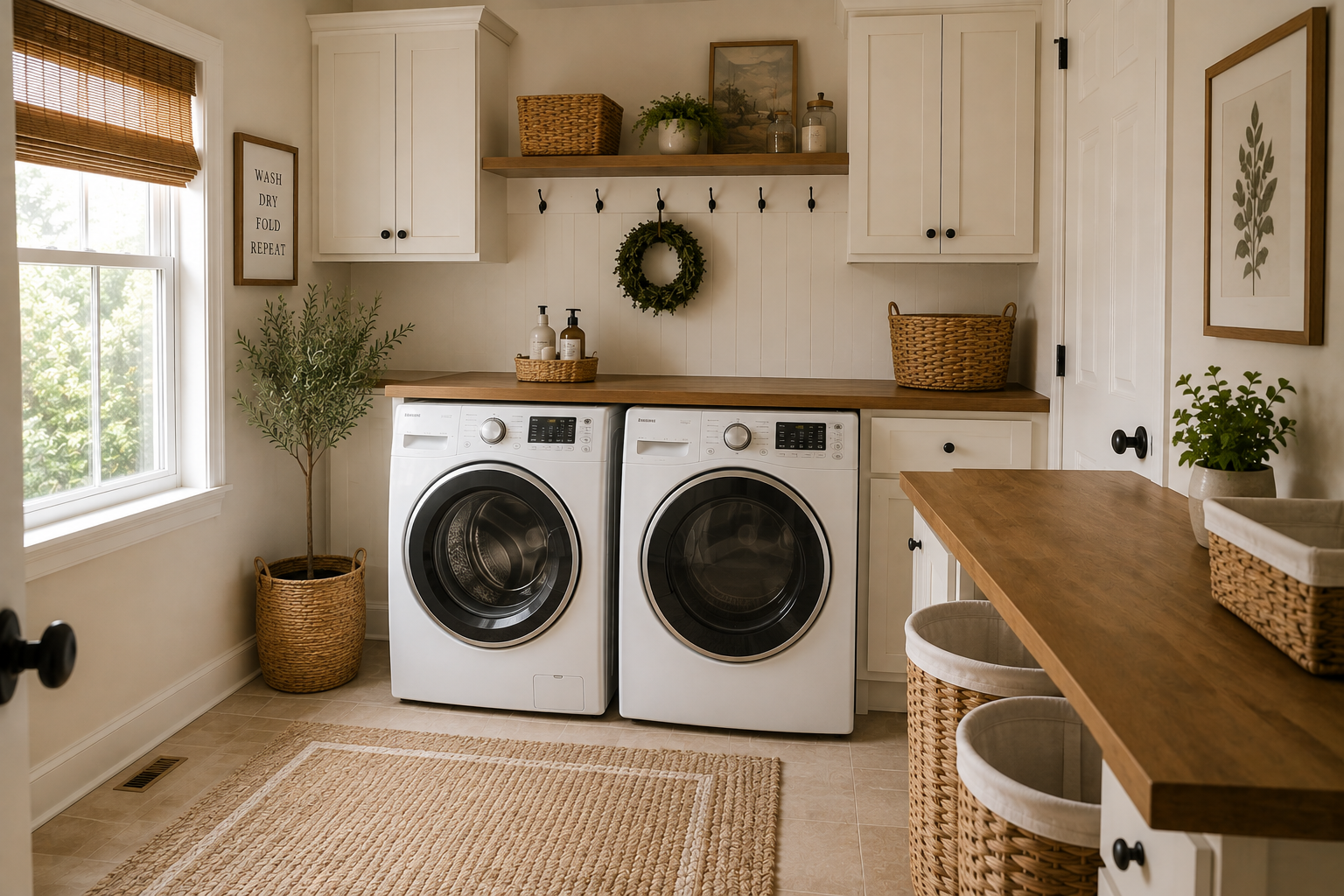
Our Calm Favorites
You don't need a room full of organizing products to create a better laundry routine.
These are the kinds of simple tools that can support the system and make each step a little easier.
Makes it easier to sort clothes as they're collected so they're ready when it's time to start a load.
Lightweight baskets make clean clothes easier to sort, carry, and return to the rooms where they belong.
Creates a designated place for air-dry clothing without permanently taking up valuable floor space.
Creates one contained place for unmatched socks or clothing that needs a little extra attention.
Final Thoughts
A calmer laundry room isn't really about having a beautiful laundry room.
It's about making an everyday task easier to finish.
When dirty clothes have a landing place, supplies are easy to reach, folding has a clear surface, and clean clothes have a simple path back to where they belong, laundry stops getting stuck in quite so many places.
You don't have to fix the entire routine at once.
Notice where your laundry usually stops.
Start there.
One hamper. One basket. One clear counter. One small routine.
Because the goal isn't to become better at doing laundry.
It's to create a system that asks a little less of you every time you do it.
Less friction. Fewer piles. A calmer home.